
Turquoise in China, Past and Present
Updated: May 24
Mike Ryan II, Allan Voshall and Stephen Gao
History flows on a river of time. It is comprised of fact, fiction, truth, deceit and outright lies. We are all players in a magnificent flow of life staged over long periods on different stages. History is written by the winners, determined as much by bias, perception and perspective as a presentation of all that actually happened. History is the combined stories of all people from different times and many places. It unfolds as geography, politics, science, culture and art within the context of the complex interaction of people over time. This article is a brief look at the history of turquoise in China.
In Turquoise in America, Parts 1-3, a comprehensive history of turquoise was presented for the first time. The task was simplified by the fact that the entire period covered a time span of 130 years. In approaching turquoise in China, the task is daunting because it covers a time span of four thousand years. In Turquoise in America Part Two, 1910-1990 in Chapter 5, “First Contact”, the story was told, through the voices of those making the story, of the brief period of just five years when Chinese turquoise was introduced to the US market in the late nineteen eighties. Their stories provide a backdrop of the socio/political conditions in China following the creation of a Communist government, The Peoples Republic of China, in 1949. That chapter provides a good background for this article.
In the US most are undereducated about China, its culture and history. History education is restricted to US history and perhaps European history. We know little about the rich culture and history of China and most perceptions are often based on political bias and misinformation. This is especially true if our understanding of China is focused only upon the quite narrow range beginning in 1949. The China of today bears little resemblance to that of the period of 1949-2000. In a recorded history reaching back millennium fifty years is a brief snapshot in time and the five years covered in “First Contact’, a mere blip.
This article is divided into geography, geology and past and present history. The past is divided into prehistorical, ancient historical and more recent history. The present will show the current state of turquoise, some of the geology and explanation of the different looks from different areas and mines.
Geography
Geography is important in understanding the history and culture of a people and a country. That is especially important in a country as large, ancient and diverse as China. Rivers are often the backbone of a nation’s history and culture. Rivers provide a source of water for use and transportation. In China the dominant river system is the Yangtse with the Han tributary. The oldest archeological evidence of human ancestors is found along this system and it has long defined much of Chinese history and culture.
In the first map we see the area of turquoise mining in relation to the entire country and in the second a more detailed map of the Yungai and Zhushan areas. Often it is easier to understand a map of a not well-known area in language with which we are more familiar. Think of Hubei as the State and Yungai and Zhushan as the Counties with the particular mines as either from a mining district or a specific mine. For example, Royston is a district in Esmeralda County ,Nevada and Royal Blue is a turquoise from a long-established mine in the Royston District.


Geology
Danny Lopacki, whose story is told in Chapter 5 of Turquoise in America Part Two, 1910-1990, when confronted with the claim that turquoise from China was not as favorable as turquoise mined in the US, would say, “Turquoise doesn’t care what country it is mined in.” That is true from an aesthetic sense but in geology all turquoise has its own signature in terms of the chemistry of the elements. In the US there has been little academic study of turquoise from geologists. This is due, in large part, because those who fund those studies are far more interested in the study of more economically viable minerals like precious metals and oil and gas. More recently China has undertaken extensive research into turquoise formation under the direction of Professor Chen Quanli (Vice Dean of the Jewelry School at CUG Wuhan), Professor Yin Zuowei (Dean of the school) and Professor Qi Lijian, (the retired director of Tongji University's Gem Lab.)


Under the guidance of Professor Qi Lijian, the key conditions for turquoise formation within the Yungai mine's siliceous slate strata have been defined.
The vibrant blue veins indicate a high concentration of copper (Cu).
The reddish-brown stains show the presence of iron (Fe).
These iron- and copper-rich gels are transported by water and slowly accumulate in the fissures of phosphorus-rich siliceous slate. Given another 100 million years, this process will complete the formation of solid, turquoise. This is the birth of a gem.
Ancient Past
The archeological evidence of the earliest record of human existence in China is Yunyxian Man with the remains of homo erectus dating to 1.8 million years. Documented history with archeological evidence coming from the Erlitou Archeological Site pertaining to turquoise goes back about four thousand years, perhaps much earlier, indicating that turquoise was mined in China from prehistoric times.
The story of Yungai Temple (Cloud-Covered Temple) is truly legendary. It is helpful to understand this history within the context of the importance of Confucianism and Taoism to Chinese culture. Confucius and Lao Tsu were roughly contemporaries around 500 BC. Confucianism and Taoism form the philosophical backbone of Chinese culture. Confucianism emphasizes societal order, morality, and filial piety to shape governance and human relationships. Taoism promotes harmony with nature, spontaneity, and "non-action" (wu-wei) to shape arts, medicine, and individual spirituality. Chinese civilization historically balanced these two traditions.
The Origin: Local tradition says the temple was founded during the Tang Dynasty (specifically the Zhenguan era, 627–649 AD). It was built by the famous Great General Yuchi Gong (尉迟恭).
The temple was named "Yungai" because of its high altitude, where the peaks are perpetually shrouded in thick mist and clouds.
The Wudang Connection: There is a famous folk saying in the region: "First came the Yungai Temple, then came Wudang Mountain" (先有云盖寺,后有武当山). Legend has it that when the Great Emperor Zhen Wu (the supreme deity of Wudang Daoism) achieved immortality, he searched for a place to establish his grand palace. He first arrived at Yungai Mountain and was captivated by its majestic atmosphere, where the clouds seemed to touch the heavens. However, seeing that a temple had already been built there, he moved on to nearby Wudang Mountain. The Wudang Mountains in Hubei, China, are a renowned UNESCO World Heritage site and the legendary birthplace of Taoist martial arts, including Tai Chi and Wudang Kung Fu.
Historical Significance: This legend suggests that Yungai’s religious history predates the massive Ming Dynasty expansions at Wudang. While much of the temple now lies in ruins—with crumbling walls and ancient dry wells—the scale of the remains and the massive stone well in front of the ruins still hint at its former glory when it was a bustling site for pilgrims.
Recent Past
Here is a detailed account of the Yungai Mine's history prior to 1953, which fills the gap before it became a state-owned enterprise.
1. Late Qing Dynasty to Early Republic (Late 1800s – 1920s). During the late Qing Dynasty, mining at Yungai was intermittent. Business was initially dominated by the Zhang family from Zhushan, followed by a wealthy landlord named Wu. In the early years of the Republic, the Zhao brothers (Zhao Yikang and Zhao Yitang) took over and built a local business empire, making the Zhaos the wealthiest family in the region.
2. The Era of Zhao Bin (1926 – 1945). The most influential figure was Zhao Bin, the eldest son of Zhao Yikang. Educated in modern schools, he secretly joined the Communist Party in 1926 while maintaining a public role as a government official and the head of the family’s turquoise business.
Scale. Under his leadership, the mine reached its largest historical scale. He recruited experts from Hubei and Sichuan and opened major markets in Beijing, Hankou, and Laohekou.
Wealth. By 1945, the family-owned workshops, oil mills, paper mills, and pharmacies, employing over 70 workers. Their assets were estimated at 8 million silver dollars, making them the most powerful clan in the area.
3. The Transition & Nationalization (1948 – 1955).
Post-War Period. After the liberation of Northwest Hubei, the era of the Zhao family ended. Between 1948 and 1953, the mine was operated by private partners (Wang Taiguo and Xu Chuanshuang).
Private Mining Ends. Private extraction officially ceased at the end of 1953.
Nationalization. In September 1954, the local state-owned turquoise mine was established. On January 13, 1955, the Yunxian Government issued Decree No. 018, officially nationalizing the Yungai Temple mine. By October 1955, it was formally named the "Hubei Province Yunxian Local State-Owned Turquoise Mine."
Interaction of Yungai and Zhushan
In the 1980s the management of the Yunxian mine and factory and the management in Zhushan had disagreements and there was some tension. When Danny Lopacki visited Zhushan in the late 1980’s looking for another source of turquoise he reported he was not warmly welcomed. The tension in the 1980s was the result of a century of contrasting fortunes between the Yungai (Yunyang) and Zhushan districts.
The "Forgotten" Imperial Legacy of Zhushan. During the Qing Dynasty, (1636/1644–1912) Zhushan was the primary supplier for the Imperial Palace. Emperor Qianlong even issued imperial decrees for its mining. The turquoise inlays in the Forbidden City are predominantly "Green Series"—the signature of Zhushan. However, after the founding of The Peoples Republic of China in 1949 Zhushan was bypassed by national exploration teams due to its poor transportation links. It fell into a long period of silence.
The "Golden Age" of Yungai (1950s-1990s). While Zhushan was dormant, Yungai became the "darling" of national policy. In 1973, the National Jade Conference was held right on the summit of Yungai Mountain. This conference enhanced the prestige of Yungai as well as officially identifying turquoise as equal to jade which has had significant cultural importance. The government poured in resources including professional geologists, advanced pneumatic drills from across China, and even massive German-imported generators. Stephen Gao’s grandfather, Mr. Gao Guojun, was the chief technician responsible for maintaining those German generators. Because Yungai was a massive, state-supported success, Zhushan felt left behind. This created a sense of local frustration and fierce regional pride.
In the 80s, Zhushan had no state factories or official export channels. Most mining there was small-scale and unofficial ("wildcat mining"). When Danny arrived, the locals likely felt a mix of emotions. They lacked the technology to meet his needs, they couldn't handle international payment systems, and they were terrified of the government finding out the source of their stones. It wasn't that they didn't want the business; they simply weren't equipped or "legal" enough to handle a foreign buyer at that time.
The Post-2000 Shift and Today’s Market. Following the market reforms of the 1990s the state-owned Yungai mine went bankrupt around 2000 and the focus shifted to Zhushan. To distance themselves from Yungai’s legacy, the Zhushan government deliberately avoided terms like "Shiyan Turquoise" or "Hubei Turquoise," branding it strictly as "Zhushan Turquoise" to carve out their own identity. One pioneer, Zhang Shigen, began exporting Zhushan turquoise to the Tucson Gem Show in the early 2000s. Tragically, he died in a car accident in 2005 on his way to the airport for a Tucson trip.
The Market Today. Today Zhushan is the global trading hub, but it faces new challenges. Legal mining has been paused for about three years due to revenue-sharing disputes between the mines and the government. As a result, the market now relies on three sources. 1. Existing stockpiles. 2. Global sourcing from importing stones from Armenia, Iran, and even "buy-backs" of Chinese turquoise exported to the US decades ago. 3. Unofficial local mining in both Zhushan and newly discovered areas in Shaanxi province. For locals, mining remains far more lucrative than farming.
The Reality of Yungai (Yunyang). The National Mine Park (shown on the blog in the Update on China video Part Two) has not yet developed a successful tourist market. But what isn’t seen is what’s happening inside the mine. Currently old debris is being removed and the shafts are being reinforced for future safety. This is a long, meticulous process. The primary goal is Safety and Preservation. Because the mine was dormant for so long, the internal structures need to be stabilized before any further activity can take place. The aim is to transform the core of the Yungai Mine into a "Standardized Scientific Observation Site."
This will result in limited, focused mining. The days of large-scale, industrial "open-tap" mining at Yungai are over. The government and the local technical team (including the heritage specialists) intend to shift toward "Micro-Mining" or "Research-Based Extraction." This means that in the future, only a very small, controlled amount of high-grade turquoise will be extracted, primarily for scientific study and for creating top-tier cultural heritage jewelry. It will be the most exclusive turquoise in the world.
Regarding the Zhushan-Yunxian dispute, problems occurred as a natural result of two different cultures: the state-backed, tradition-heavy pride of Yunxian (Yungai) versus the entrepreneurial, "wild-west" energy of Zhushan. In the future there will be increased communication and focus on the development of the turquoise trade.
Recognition for Yungai
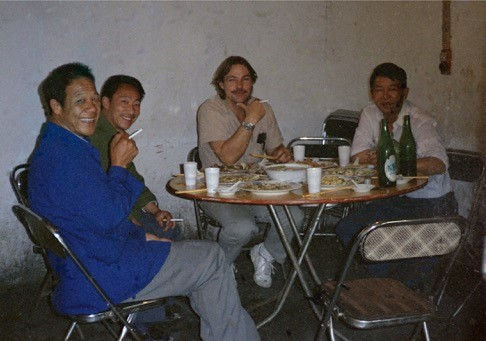
During the period covered in Chapter 5 and continuing through 2000, the Yungai Mine achieved much success and prominence. The stories in Chapter 5 describe the efforts of a small group of Americans engaging in an export business with a group of Chinese for whom this was a new experience. During that time the mine and the cutting factory received government recognition and praise, quite rare for that time.
A mine delegation traveled to the United States for the Tucson Gem Show at the end of January 1994. At that time, the General Manager of the mine was Chen Runxiang. The Deputy General Managers were Gao Ping and Huang Xinyun. Only those three, along with a translator named Huang Jihui (whom they hired from the Wuhan Zhongyuan International Trade Company), made the journey to America. The photograph below was taken at that 1994 Tucson Gem Show. The three men standing in the photo, from left to right, are Gao Ping (left) ,Chen Runxiang (center) and Huang Xinyun (right). In front of Huang Xinyun on the table is a premium slab of the highest grade of Yungai turquoise. Its front cross-section has a unique crescent half-moon shape and it weighed a massive 7 kilograms. It was of such extraordinary quality that elders in the Chinese turquoise community still frequently talk about it to this day. It was sold at the show to an American-Chinese jeweler named Song Yunlong.

Other honors at that time included a recognition from national and local Communist Party officials in 1986 and, in 1988, a Ministry of Light Industry Award to the Hubei Yunxian Turquoise Craft Factory for excellence in industrial export which was, for that time, a great achievement in China. This brought honor and prestige to the Yungai Turquoise Mine and those working there.
According to Stephen Gao, in the 1980s, China was just opening up to the world, and earning foreign currency through exports was a top national priority. The arrival of Ron Alexander, Allan Voshall, and Danny Lopacki, with their expertise in upgrading the cutting shop and opening up the U.S. market, was the exact catalyst the Yungai factory needed. It was precisely because of this successful international collaboration and the resulting high-quality exports that the Ministry of Light Industry and national and local leaders took notice, leading to those prestigious awards.
This cooperation between countries and the ongoing relationship between participants continues.

Future Plans
1. Focusing the World's Eyes on Yungai.
The current work (debris clearing and reinforcement) is a prerequisite for responsible, limited production. It is a powerful narrative. It tells the world that Yungai is not a "dead" relic, but a "sleeping giant" being managed with modern, professional standards. This shifts the focus away from the chaotic trading of the last few years and back to the prestige of the source.
2. Easing Market Concerns.
The "Wild West" era of Chinese turquoise—characterized by unregulated mining and unpredictable pricing—did indeed damage international trust. By moving toward Micro-mining and Scientific Extraction, China is essentially adopting the "De Beers" model or the high-end "Heritage Mine" logic. This ensures that the supply is always matched by the highest quality and that the provenance is impeccable. This is believed to be the best way to protect valuable assets and ensure that Hubei turquoise is treated with the same respect as other highest-grade turquoise.
3. The Aim of Professionalism.
The goal is to prove that Yungai turquoise isn't just a commodity; it’s a finite, historic asset. By managing the production responsibly, the intention is to provide the international market with predictability, stability and quality. The international market values stability and transparency as much as it values the gems themselves. An important part of this transparency is adopting standards of treatment in the identification of turquoise with natural turquoise reserved only for turquoise that has received no form of treatment. The types of treatment are further defined in the standard as oil based, plastic infusion by acrylic or epoxy polymer (stabilized) or by the Chinese version of the Zachery treatment (enhanced.
The Turquoise
With all turquoise different mines may have the same look and each mine may have different looks. This is true with Chinese turquoise. In order to better understand the different looks and grades it will be helpful to see and have an explanation of different looks from both Yungai and Zhushan. These descriptions come from Stephen Gao (Gao Chuang) who is the Sales Manager of the Yungai Turquoise National Mine Park. The Yungai Mine is currently a large conglomerate owned by the state with a primary business of tourism and hospitality.
Yungai
During the period covered in Chapter 5, the turquoise exported to the US consisted of the highest grade of Yungai that could be sorted and graded from the many tons of turquoise of different looks and grades. This became the accepted look known as Yungai, Yungai Temple or Cloud Mountain. With increased standardization this grade and look will be marketed as Yungai Blue Flower.
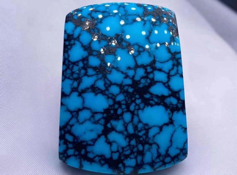
“Wu Lan Hua” (Blue Flower) (乌兰花) from the Yungai Mine. This represents the absolute pinnacle of Yungai turquoise. In our professional grading, a specimen must strictly meet four criteria to be labeled as true Wu Lan Hua.
Deep Blue Base: A rich, saturated dark blue color.
High Density: Exceptional hardness with a porcelain-like (high-luster) finish.
Fine Black Webbing: Delicate, hair-fine black iron lines.
Uniform Distribution: The webbing must be perfectly even and symmetrical across the stone.
As the photos show, even in a premium rough stone, only specific sections meet all four criteria simultaneously. We often "surgical-cut" the stone to isolate these rare, perfect pieces.
The Yungai Turquoise Mine (aka Yungai Temple Mine and Cloud Mountain Mine) has produced very little in recent years, and authentic “Wu Lan Hua” has become extremely rare. The stones shown are the very highest (Gem Grade) Wu Lan Hua (Blue Flower).


Blue Net Flower (蓝网花).This is used when the base color is a beautiful deep blue, but the webbing distribution is uneven or less symmetrical compared to the strict Wu Lan Hua standard. By differentiating these, we help collectors understand that while "Spiderweb" and "Blue Net" are beautiful, they are distinct from the rare "Wu Lan Hua.




Yungai Polychrome (云盖多色)
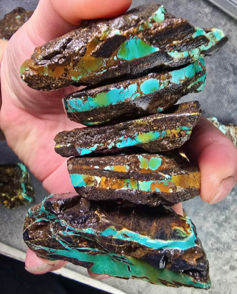
This series comes from a very specific location near the peak of the Yungai Mountain mine. Because the rock layers are relatively thin at this altitude, the turquoise is heavily influenced by the infiltration of surface pyrite and iron-rich siliceous slate.
This natural geological process creates several unique characteristics:
Chocolate Matrix. The surrounding slate turns a distinct chocolate brown due to the high iron content.
Vibrant Palette. The turquoise absorbs these minerals, resulting in a rich, multi-colored appearance within a single stone.
Unique Environment. Inside the mining tunnels of this area, there is a strong, distinct smell of sulfur. You can actually see "iron-rich gel" (liquid mineral deposits) flowing down the cave walls, which is what gives this material its incredible colors. It is a true testament to the complex mineral chemistry of the Yungai mine.



Yungai Black Silk (云盖黑丝)
This variety bears a striking resemblance to the American "Blackjack" turquoise. Its formation and mining history are quite unique.
Geological Formation. During the formation period, turquoise gel rapidly filled into the fractured zones of siliceous slate. This specific ore belt is located at the western end of the Yungai Mountain mine, where the siliceous slate is exceptionally thick and hard.
The "Splitting" Process. Historically, this material was underutilized in China due to the extreme difficulty of extraction. To harvest the turquoise, miners had to use blunt knives or axes to manually split the hard rock. It was incredibly labor-intensive; a worker could only retrieve a few kilograms of fragmented pieces per day. In the past, the parts where the turquoise was as thin as a thread were simply discarded.
Global Recognition. After realizing that similar "Blackjack" looks were highly valued in the U.S. market, the mine began specifically collecting this material. Tons of this turquoise were eventually salvaged and supplied primarily to international markets. It is characterized by its deep blue color contrasted against the sharp, dark, and hard matrix, telling a story of both geological pressure and intense manual labor.


Yungai Blue (云盖蓝与青皮籽)
In the Chinese market, "Yungai Blue" and "Green-Skin" materials (turquoise with a thin green outer crust) are highly coveted. Unlike the American market, which often prioritizes turquoise for silver and gold jewelry, the Chinese preference is deeply rooted in Jade Culture.
Carving vs. Setting. We prefer to use these clean, matrix-free stones for intricate carvings. Because of our tradition, turquoise is often carved into Buddhist figures or auspicious symbols, serving as a protective "talisman" or spiritual object for the wearer. While China produces many shades of blue, "Yungai Blue" is considered the gold standard for three specific reasons:
Deep, Pure Hue. It possesses an incredibly saturated and deep blue that remains pure without leaning towards green.
High Translucency. The material has a unique "jelly-like" quality. When held to a light source, it exhibits a beautiful translucency, which is a key indicator of its high quality to Chinese collectors.
Superior Texture. It has exceptional density and hardness, with a fine-grained texture that allows for the most delicate carving details.
This material represents the bridge between mineralogy and spiritual art in our culture.


Yungai Green-Skin Specimens (青皮籽)
"Green-Skin" is another famous variety from the Yungai Mine known for being clean and free of iron lines. It shares almost the same high standards as "Yungai Blue" in terms of texture and quality, with one primary difference in color.
Color Profile. While "Yungai Blue" is a pure, deep blue, "Green-Skin" turquoise leans slightly towards a lush blue-green or teal hue.
The "Skin" Phenomenon. The name comes from its raw state—these nodules are typically covered in a thin, green mineral crust. Once opened and polished, they reveal a high-porcelain, vibrant blue-green interior.
Jade-like Quality. Like its blue counterpart, "Green-Skin" is prized for its exceptional density, fine grain, and slight translucency. Its slightly warmer tone makes it a favorite for traditional carvings that aim to mimic the serene quality of high-end green jade.
It is a perfect alternative for those who appreciate the porcelain texture of Yungai material but prefer a more organic, teal-leaning color palette.


Geological Context for Yungai Blue & Green-Skin
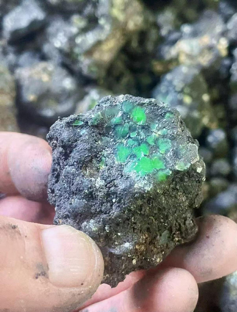
Both varieties originate from the lowest ore belt of the Yungai Mine, situated at an altitude of approximately 700 meters (about 200 meters below the peak). This layer is renowned for producing turquoise with the most stable color and exceptional density.
Formation & Structure. The turquoise develops within the squeezed and fractured zones between layers of siliceous slate. It typically occurs in lenticular (lens-shaped) or nodular forms, following the natural bedding of the rock. You will often find them mixed with carbonaceous and argillaceous (clay-like) rock fragments.
The "Bead" & "Lotus Root" Growth. They appear as individual units or in clusters that resemble a string of beads or segments of a lotus root (藕节状). While the nodules are generally small, the lenticular bodies are completely filled with pure turquoise.
The "Soft Lead" (软引). Locally, we call this type of occurrence "Ruan Yin" (Soft Lead). Unlike materials that are tightly squeezed into thin plates against the hard slate, these nodules are embedded in a softer mixture of carbon and clay. This "soft" surrounding allows the turquoise to develop fully into a rounded, high-quality form with superior structural integrity. It is this unique "soft" environment within the hard mountain that allows for the creation of such perfectly matured, high-porcelain stone.
Yungai Sunflower Yellow (云盖菜籽黄)
This variety is one of the most distinctive and historically intriguing types from the Yungai Mine.
Mineral Composition & Comparison. Scientifically, it is a zinc-bearing turquoise, which gives it a vivid, yellowish-green to bright green hue. It bears a striking resemblance to the famous Damele or Carico Lake turquoise from the United States.
The Certification Breakthrough. For a long time, this material could not receive official "Turquoise" certificates in China because its spectral signature differed slightly from standard copper-rich turquoise,
New National Standards. This has recently changed. With the implementation of the new National Standard (GB) for Turquoise, this material is now officially recognized. It can now pass national gemological testing as genuine turquoise, often with the specific trademark "Sunflower Yellow" (菜籽黄).
Aesthetic Value. It is prized for its unique "oil-like" or "wax-like" luster and its vibrant, spring-green color, making it a favorite for collectors who look beyond the traditional blue.


Zhushan
Water Grass Pattern (水草纹)
This is another unique and highly artistic pattern found in Chinese turquoise, primarily originating from the Dongzigou Mine in Zhushan. Unlike the structured geometric grid of a spiderweb, this pattern features delicate, branching iron lines that mimic the organic look of underwater plants or aquatic weeds swaying in a current. It is prized for its natural, fluid aesthetic, often appearing on a high-porcelain blue or teal base, creating a scene that looks like a miniature botanical painting captured within the stone.

Moon River (月亮河)
It is important to clarify that "Moon River" is not the name of a specific mine in China. Instead, it is an aesthetic classification used to identify high-grade turquoise with a specific look, originating from the Qingu Mining Area in Zhushan.
Definition by Standard. Turquoise is only designated as "Moon River" if it meets a specific visual and quality profile. It is a market and collector-defined standard rather than a geographical one
Visual Characteristics. It is characterized by a deep, intense blue base paired with flowing, natural black iron lines. The contrast is meant to evoke the image of a bright moon reflecting on a dark, moving river at night.
Quality. Beyond the pattern, Moon River material must possess high density and a porcelain-like luster to be recognized under this name.
This distinction is crucial for international collectors to understand: while it comes from the Qingu district, "Moon River" represents the selection of the finest, most artistic pieces from that region's output.


Sunset River (落日河)
Similar to Moon River, "Sunset River" is not the name of a specific mine. It is an aesthetic classification for turquoise that originates from the Zhushan mining area and meets a very rare color standard.
Aesthetic Standard. While Moon River focuses on the contrast of "Moonlight on Dark Water," Sunset River captures the breathtaking colors of a sunset reflected on a river.
Visual Characteristics. It is defined by a unique co-occurrence of colors within a single stone—typically featuring a vibrant blue or teal base intertwined with warm orange, yellow, or reddish-brown limonite matrix.
The "Fire and Ice" Effect. The beauty of Sunset River lies in its "warm and cold" color collision. The warm-toned matrix flows through the cool-toned turquoise like the last rays of the sun hitting the water at dusk.
Rarity. Because it requires a very specific mineral composition (the perfect balance of iron and copper) to create this particular "sunset" palette, it is one of the most sought-after artistic varieties from Zhushan.
This classification helps us distinguish these highly poetic, multi-colored stones from standard matrix turquoise, highlighting their value as natural "landscape" masterpieces.


Water Ripple Turquoise (水波纹)
This is a highly sought-after variety currently trending in the Chinese market. Like Moon River, "Water Ripple" is not tied to a specific mine but is an aesthetic classification based on strict quality and visual standards.
Visual Characteristics. It is defined by its exceptional porcelain-like luster and beautiful color. The most striking feature is the internal pattern, which looks like rippling or flowing water frozen within the stone.
Geological Formation. From a mineralogical perspective, this "flow" pattern is the result of a unique precipitation process during the turquoise's formation. It occurs when turquoise gel fills the rock cavities in multiple stages or under fluctuating pressure, leading to rhythmic layering or "fluid" structures.
Academic Support. This phenomenon was specifically researched and explained by Professor Yang Mingxing, the former Dean of the Jewelry Institute at the China University of Geosciences (Wuhan). He published a professional paper detailing the precise geological conditions required to create these water-like undulations. According to the research by Professor Yang Mingxing, this flowing pattern is a result of 'rhythmic growth' and 'chemical oscillation' during the mineral's formation.


Conclusion
China was one of the earliest countries to mine turquoise. It may have the largest reserves of any country. During the period covered in Turquoise in America, Part Two 1910-1990 in Chapter Five “First Contact”, the period of the early 1990’s to 2000 was a time when much Chinese turquoise was introduced to the US market, much of it treated, with little quality control. There was disruption to the market which resulted in distrust of Chinese turquoise which resulted in many regarding it as inferior. Over time this perception has lessened but Chinese turquoise remains underpriced relative to similar grade of US turquoise and a relative value.
In this article we have presented a brief background of the long history of Chinese turquoise and the recent programs to create standards which will provide transparency, stability in the market and increased trust. The variety of Chinese turquoise offers a wide range of looks and beauty. Turquoise is a special stone that unites the energy of the sky and the earth, regardless of the ground from which it came.

Very enlightening article. It just goes to illustrate that it doesn't matter where turquoise comes from, it is universally attractive.